
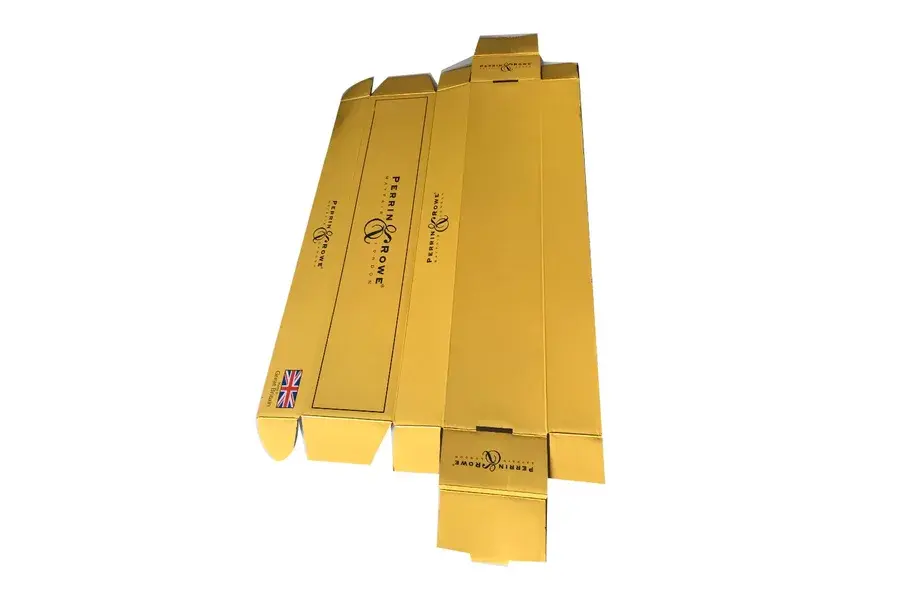
Choose an orientation
Place the product as it will sit in the pack and identify the opening face. Record length, width and height in a stated order and unit. Without the orientation and dimension order, a supplier may interpret the same numbers differently. Include a dimensioned sketch even if the final dieline is not ready.
Measure the complete contents
For a set, measure the arrangement rather than adding individual product widths. Include gaps, dividers, wrapping and access space. Treat external dimensions as a separate shipping input because board, folds and overlapping parts occupy space outside the usable cavity.
Check a sample
Example brief: “The dimensions describe usable internal space. The product stands upright with the cap at the opening. An insert is included in the measurement. Please confirm fit with the complete product before finalising the dieline.” This identifies the measurement basis without inventing a universal clearance.
Related specification support
Custom Packaging Sizes
Translate product measurements into a clear packaging dimension specification.
Distinguish allowance from tolerance
An allowance provides deliberate room for wrapping, inserts, assembly or product removal. A dimensional tolerance describes the agreed acceptable variation around a specified dimension. Do not use the two terms interchangeably or apply a fixed allowance to every structure. Confirm both on the actual grade and assembled sample before approving the order.
Measure a complete packed example
Illustrative example: a product occupies 120 × 80 × 35 mm before wrapping. Adding an insert or wrap changes the packed arrangement. Record those product dimensions first, then measure the complete arrangement and agree the usable cavity. Do not order a box with those same numbers without checking fit.
Dimensions to record before ordering
| Check | What to do | Why it matters |
|---|---|---|
| Product | Measure the widest points in the chosen orientation. | Product dimensions are not finished box dimensions. |
| Packed arrangement | Include the insert, wrap and accessories. | Hidden components still consume space. |
| Finished sample | Check insertion, closure and removal. | Fit allowance and production tolerance are different. |
Record the actual product, material or file version used for the comparison. Identify what remains undecided and which sample or document can resolve it.
Discuss measurement and fit checks
Send the product measurements, proposed pack and available specifications, with a sketch or sample showing the fit question.
How to Measure a Box FAQ
Yes. Recheck the usable cavity and opening when the insert, wrapping or product orientation changes. A nominally identical product can need a different packed arrangement.
Use internal dimensions to specify usable space for the product, insert and wrapping. Record external dimensions separately for shipping: board, folds and overlapping parts add to the finished box size.
Allowance is deliberate space for packing, assembly or product removal. Tolerance is the agreed acceptable variation in a specified dimension. Confirm both on the selected material and assembled sample; neither is a universal clearance.